
In June 2022 I let an AI content generator write a post for this blog. I typed in a few parameters, took what came back, amended it, formatted it, put “by AI” in the title and an AI-generated image on top, and published it. Everything else, the layout, the image, the page itself, was done by hand in the editor. ChatGPT didn’t exist yet. It arrived five months later.
I’m looping back to it on purpose. The five benefits are still here as the machine wrote them, and I’ve answered each one again. The bigger change is in how a post like this gets made now, so this is also a look at what four years did, with a timeline of what came out in between.
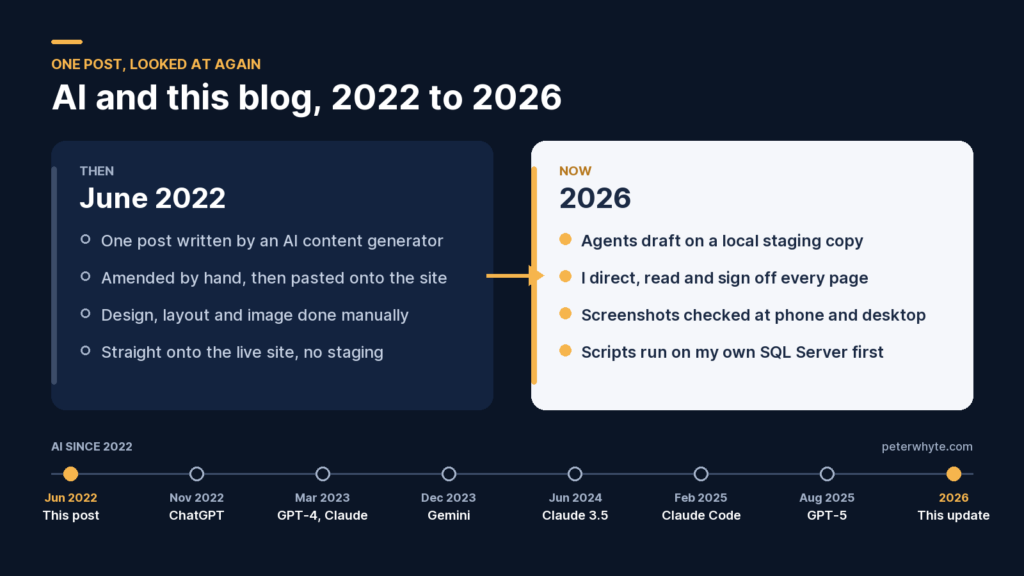
One post out of an AI content generator, amended by hand, formatted by hand, pasted onto the site. The design, the image and everything else done by me, straight onto the live site.
Agents draft on a local staging copy of the site while I direct. I read every page, and its screenshots at phone and desktop width, before anything goes live. The push is a command I run myself.
What the AI Wrote in 2022
The original post, kept as the machine wrote it:
“If you’re like most people, you probably don’t have a lot of extra time on your hands. You’re probably always looking for ways to save time, whether it’s by using a time-saving tool or by outsourcing a task to someone else.”
“In conclusion, the benefits of AI content writing are many.”
The AI content generator, June 2022. Benefit one and the conclusion.

Then: How That Post Got Made
There wasn’t much to it. The generator took a few parameters and gave back the five benefits and their paragraphs. I went through it, amended what I didn’t like, formatted it in the WordPress editor, generated the image from one keyword and put it on top. The page design was whatever the site had at the time. Nothing sat between me and the live site, so the moment I pressed publish it was up.
The thing worth remembering is what a normal post cost me back then. A good one took something like eight hours, getting it out of my head and onto the page, and a technical post meant scripting and testing on my own machines on top of that. That friction is the real reason I was never consistent with blogging. It was never a shortage of ideas.
Now: How This Post Got Made
This update was built the way everything on my sites is built now. The order matters, because the human part moved to the end.
- I set the directionWhat the post should be, what it must not claim, and what I want shown. The brief is mine, and so are the facts in it.
- An agent drafts it on stagingA local copy of this site that nobody else can see. The words, the layout and the image above all land there first.
- I read it as a readerStaging and live side by side. Anything wrong, or anything that doesn’t sound like me, goes back with a note.
- Screenshots at phone and desktop widthEvery page is captured at 390 and 1280 pixels and looked at before it reaches me. Layout problems get caught there, not by a reader.
- I run the pushA dry run first, then the command, run by me. Nothing goes live on either of my blogs that I haven’t read.
On sqldba.blog there’s one more step. Every script is run against my own SQL Server instance before its page goes live, and the screenshots on the page are mine, taken from that run. The design of this site works the same way. The navy and amber, the cards, the steps above and the timeline below are a small library of components that were proposed on staging, looked at on a phone, and kept or sent back.
So the eight hours didn’t vanish, they moved. An evening with it can be a hobby now. The writing got fast and the reading became the job, and that’s the part that doesn’t shrink.
The Five Benefits, Answered Again
Save Time: Yes, but the Time Moves
This one was right, and it mattered more to me than the AI could have known. It took most of the cost of a post away. What the 2022 list didn’t mention is where the time goes instead. Every page still has to be checked by someone who knows the subject, and if you skip that part you haven’t saved time, you’ve borrowed it.
Better Quality: Only If Someone Reads It
The original post is its own evidence here. Its quality section spends four paragraphs saying very little and finishes with “AI content writing tools can help you save time and money”, which was point one.
Running scripts against a real instance catches the things that are wrong. It doesn’t catch the things that are hard to read, and I’ve sent back rewrites that were completely accurate because the intro took too long to get anywhere or the headings narrated instead of telling the reader what they’d find. Accurate and readable are two separate checks, and AI passes the first one long before it passes the second.
Stay on Topic: Too Well, Sometimes
AI stays on topic better than most people do. It does exactly what it’s asked, quickly, and that’s where the trouble usually starts. I had a full report on my search traffic come back once with every number correct, worked out over a window far too short to mean anything. The machine answered the question perfectly. The question was the problem, and the report went in the bin.
It drifts in one way I never expected, too. I’ve found its own working notes sitting in the middle of published posts, a line about fixing a bug while testing, written to nobody in particular. A reader wouldn’t have known anything was off. I only spotted it because I read the page properly.
Target Your Audience: It Needs You to Name One
Left to itself, AI writes for everyone, which is how you get an opening line like “If you’re like most people”. It’s very good at writing for a particular reader, but only once someone has told it who that reader is.
For sqldba.blog I decided the reader is a DBA in the middle of an incident, holding an error number or a symptom and wanting the next command to run. That changes almost everything about a page: lead with the check, write to the symptom in the words they’d search, keep the background for later. The AI writes to that brief well. The brief came from years of being that DBA, and no tool was going to hand it to me.
Help With SEO: Words Are the Cheap Part Now
In 2022 the idea was that AI would help you write content closer to your keywords and rank higher. What I see now is the opposite problem. Anyone can produce a thousand pages in a week, so pages on their own are worth less every year. My technical blog has hundreds of posts, and the thing holding it back isn’t the amount of writing, it’s authority, other sites trusting it enough to link to it. Adding more pages can thin that out rather than build it.
So the work I’m doing there is mostly keeping existing posts accurate, linking them together properly, and adding something new only when it ties into what’s already there. AI makes that work quicker. It doesn’t decide what’s worth doing.
AI Since 2022: A Timeline
The public milestones, with my own markers on the same line. Four years is not long for this much to have happened.
- June 2022This post goes up
Written by an AI content generator, labelled “by AI” in the title. Five months before ChatGPT.
- 30 November 2022ChatGPT launches
OpenAI’s free research preview, the moment most people first met AI writing.
- 14 March 2023GPT-4, and the first Claude
GPT-4 arrives for ChatGPT Plus. Anthropic releases its first Claude the same day, as a limited release.
- 6 December 2023Google Gemini 1.0
Google’s answer, in three sizes, available through Bard from the same day.
- December 2023I write down what I think 2026 will look like
What AI Will Be Like in 2026. Worth reading against the rest of this list.
- 14 May 2024Google AI Overviews
AI-written answers go above the search results in the US. Search itself starts to change.
- 20 June 2024Claude 3.5 Sonnet
Anthropic’s model beats GPT-4o on most of its own benchmarks, and Artifacts arrive alongside it.
- 25 November 2024Model Context Protocol
An open standard for connecting AI to tools and data. The plumbing behind agents that act, not just answer.
- 24 February 2025Claude Code research preview
An agent in the terminal that reads files, edits them and runs commands. The shape of the work changes here.
- 22 May 2025Claude 4 and Claude Code goes general
Opus 4 and Sonnet 4 at Anthropic’s developer event, and Claude Code out of preview.
- 7 August 2025GPT-5
OpenAI’s next headline model, rolled out to ChatGPT users on launch day.
- November 2026This update
Drafted by agents on a staging copy of this site, read and signed off by me. The 2022 post stays underneath it.
The One It Left Out
The 2022 list never mentions a human, and I was only in that post as the person who formatted it. Now I’m the reviewer, which is the bigger job and the one that doesn’t shrink.
My view is that someone’s ten or twenty years of work on the internet can now be copied in a day with AI, and copied properly. The people who come out ahead are the ones who put in those years, because they know how to guide it in their own niche. Mine is SQL Server and this blog. The original post stays where it is, with “by AI” still in the title.
Comments
One response to “5 Benefits of AI Content Writing, by AI, Answered by a Human (2022 to 2026)”
Wow, this is so neat! I could see this being extremely useful.